

Contents
The evaluation begins with institutional fit
Family offices differ in mandate, liquidity needs, tax residency, and tolerance for concentration. Some seek current income and long-duration ownership. Others allocate to value-add strategies where capital is deployed, improved, monetized, and recycled through shorter cycles. Neither preference is inherently superior. The relevant question is whether the operator’s strategy, holding period, and capital structure fit the family’s broader balance sheet.
A serious allocator first asks whether the manager can articulate what it does not do. An operator that pursues every property type, every geography, and every market condition may be flexible, but it may also lack the specialization needed to maintain pricing discipline. By contrast, a defined mandate creates an evaluable operating perimeter: target assets, acquisition criteria, value-creation plan, leverage limits, exit logic, and circumstances in which the firm will walk away.
Part of how family offices evaluate real estate operators in Florida residential value-add strategies is the precision of the strategy perimeter. The difference between an attractive basis and an impaired investment can rest on title quality, insurance availability, permit timing, construction scope, neighborhood liquidity, or the assumptions embedded in the resale window. Family offices look for managers that treat these issues as underwriting inputs, not post-acquisition surprises.
How family offices evaluate real estate operators beyond returns
Historical performance matters, but it is an incomplete record. Family offices examine how returns were produced, how capital behaved during adverse periods, and whether the manager’s stated process corresponds with actual decisions.
Attribution matters more than a composite number
A realized track record should be reviewed deal by deal. Allocators want to distinguish market appreciation from operational value creation, and recurring execution skill from an isolated exceptional outcome. They examine original underwriting against realized results: purchase price, renovation budget, schedule, financing costs, disposition assumptions, and net proceeds.
They also ask for the less flattering files. Failed bids, canceled contracts, projects that exceeded budget, delayed exits, and investments with lower-than-expected outcomes often reveal more than a polished case study. The question is not whether a manager has encountered friction. In private real estate, friction is inevitable. The question is whether the manager recognized it early, documented its impact, escalated it properly, and preserved decision quality.
That capacity to explain variance without evasion is central to how family offices evaluate real estate operators. A mature operator identifies whether the cause was execution, market movement, a third-party dependency, or an underwriting error, then shows the control added to reduce recurrence.

Comparing real estate operators for a family office allocation?
ARCSA Capital provides transaction level attribution, in house execution and asset level reporting for institutional allocators.
Request InformationRepeatability is tested at the operating level
Family offices are wary of returns that depend on a single principal’s intuition or a market that no longer exists. They assess whether sourcing, diligence, project management, legal oversight, and disposition can be repeated without sacrificing standards as capital scales.
This is where proprietary access receives scrutiny. Off-market opportunities can offer meaningful advantages, but the claim alone has little value. The allocator will ask how opportunities enter the pipeline, who controls the relationship, what percentage converts into acquisitions, and why the seller accepts the proposed terms. A credible sourcing engine is supported by local relationships, documented selection criteria, and a demonstrated ability to reject transactions that do not meet the mandate.
The same scrutiny applies to accelerated exits. A short projected hold can improve capital velocity, but it concentrates execution risk. Family offices want evidence that the operator has planned for appraisal risk, buyer financing failures, insurance delays, title issues, shifting demand, and the possibility that a property requires more time than the base case assumes.
Governance is a capital protection mechanism
For institutional capital, governance is not administrative decoration. It is the architecture that determines who may commit funds, approve exceptions, alter budgets, engage related parties, and communicate material developments.
A family office will evaluate the legal entities through which capital is raised and deployed, the authority of the general partner, the role of investment committees, and the procedures governing conflicts of interest. It will review subscription materials, operating agreements or partnership documents, fee provisions, valuation policies, distribution waterfalls, and the rights available to limited partners.
The standard becomes more exacting in cross-border structures. International investors require clarity on tax reporting, withholding, fund domicile, investor eligibility, beneficial ownership procedures, and the interaction between U.S. operations and any parallel vehicle. A structure designed with counsel, administrators, tax specialists, and independent audit processes is materially different from a structure assembled around a transaction.
When determining how family offices evaluate real estate operators, regulatory posture is never an afterthought. It is evidence that the manager understands the boundaries of its offering, maintains appropriate records, applies investor qualification procedures, and can operate under institutional review — including standards set by the U.S. Securities and Exchange Commission. Precision in compliance frequently signals precision elsewhere.
Underwriting reveals the operator’s true culture
An investment memorandum can be elegant while its assumptions remain fragile. Experienced allocators therefore inspect the underlying underwriting model and the approval process behind it.
They look for conservative treatment of acquisition costs, permits, contingency, insurance, property taxes, financing, broker fees, carrying costs, and disposition expenses. They examine comparable sales and demand assumptions, then test whether the projected exit price remains defensible after a reasonable reduction in price or extension in time.
The critical distinction is between a projected return and a protected downside. A manager should be able to show the base case, downside case, and break-even thresholds without treating stress testing as a concession. If a project needs perfect construction execution and an uninterrupted resale market to perform, the risk belongs in the underwriting, not in a footnote.
Leverage deserves equal attention. Debt can enhance capital efficiency, but it can also force decisions at the wrong moment. Family offices assess loan-to-cost discipline, maturity profiles, rate exposure, covenant risk, extension options, recourse, and liquidity reserves. The appropriate leverage level depends on the asset and business plan, but a manager should never confuse available debt with prudent debt.
See how family offices evaluate real estate operators at ARCSA Capital
ARCSA Capital is built for institutional allocators who demand governance, off-market access, and a private equity mindset applied to prime Miami residential. Request a private conversation with our investment team.
Request a Confidential BriefingExecution capacity separates sponsors from real estate operators
Real estate returns are often won after closing. Family offices want to know who controls the rehabilitation scope, approves change orders, monitors contractors, handles permits, verifies draws, and makes the decision to adjust pricing or exit timing.
The strongest real estate operators provide a clear chain of accountability. Investment personnel, asset management, construction oversight, legal counsel, accounting, and disposition teams may have distinct responsibilities, but information must move quickly between them. A budget overrun discovered late is not merely a construction issue. It affects return expectations, liquidity planning, and investor reporting.
Technology can improve visibility, particularly where a portfolio includes multiple projects at different stages. Yet dashboards are only useful when the underlying data is timely and independently checked. Family offices evaluate the cadence of reporting, the definition of key metrics, and the manager’s willingness to disclose exceptions promptly.
When thinking about how family offices evaluate real estate operators, ARCSA Capital’s Prime Residential Value Add Institutional approach answers each question directly: control over sourcing, underwriting, rehabilitation, repositioning, and monetization is designed to reduce handoffs that can dilute accountability. Control does not eliminate risk. It creates a clearer line of sight to it.
Alignment must be economic and behavioral
Family offices review management fees, acquisition fees, development or oversight fees, disposition fees, carried interest, and expense allocation in detail. The goal is not necessarily to select the lowest-fee manager. A low-cost structure can become expensive if it rewards deployment volume over selectivity or encourages a premature sale.
Alignment is strongest when the operator has meaningful capital invested alongside investors, earns incentive compensation after clearly defined performance thresholds, and remains accountable for the quality of realized outcomes. The details of the waterfall matter because incentives shape behavior under pressure.
Behavioral alignment also appears in communication. A manager that reports only favorable developments is difficult to underwrite. A manager that communicates material risks early, explains the decision path, and provides the supporting data gives a family office what it needs most: the capacity to govern its own capital allocation.
The final decision is often about trust under pressure
Before committing capital, sophisticated families conduct reference checks with prior investors, lenders, service providers, brokers, attorneys, and operating partners. They compare each conversation with the manager’s narrative. Inconsistency is a signal. So is a reluctance to provide access to the people and documents responsible for execution.
The answer to how family offices evaluate real estate operators is ultimately a test of discipline. The most investable operator is not the one that promises an effortless path. It is the one that demonstrates disciplined selection, institutional documentation, and the judgment to preserve capital when market conditions diverge from the original plan.
Apply the standard of how family offices evaluate real estate operators
ARCSA Capital provides family offices and qualified investors with institutional-grade access to off-market Miami residential opportunities. Structure, governance, and discipline built in from day one.
Talk to Our Investment TeamReal Estate Operators: 8 Points at a Glance
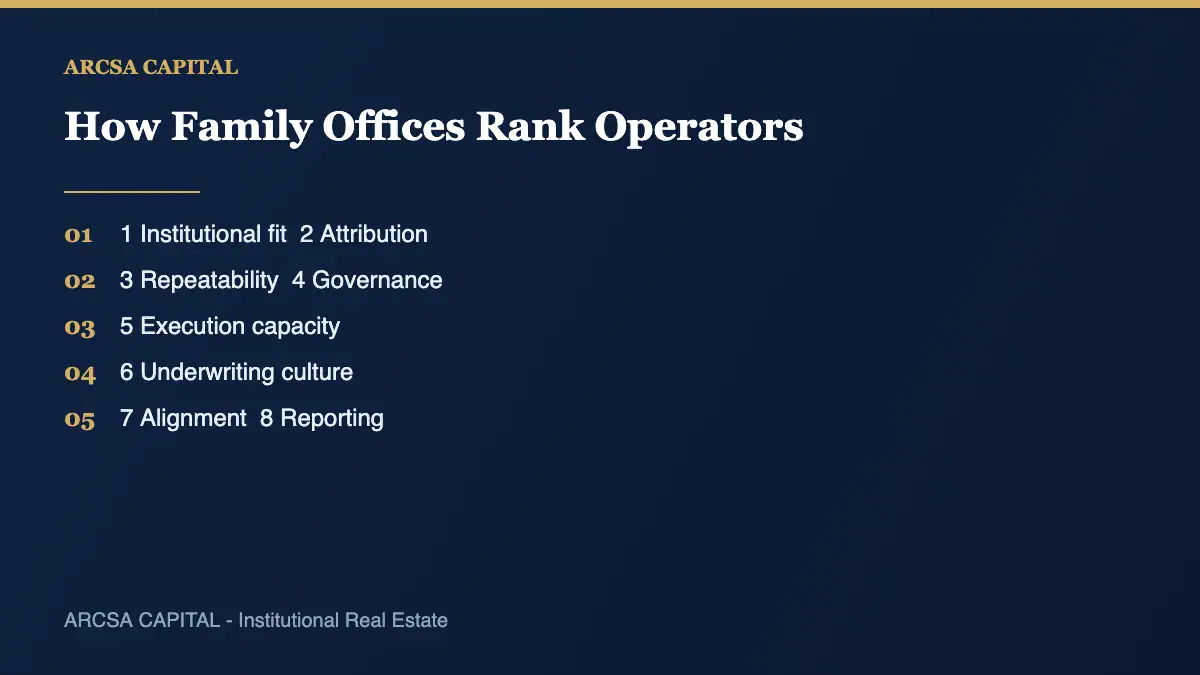
Family offices rarely reject real estate operators because of a weak return figure. They reject them because the process behind the figure cannot be explained. The eight points below describe what is actually assessed, in the order it is assessed.
- Institutional fit. Whether the mandate, ticket size, hold period and reporting standard of the operator match the family office rather than the other way around.
- Attribution. Which portion of past performance came from market movement, from leverage, and from decisions the operator actually made.
- Repeatability. Whether the process that produced one result can produce another, or whether the record depends on a single exceptional transaction.
- Governance. Investment committee composition, advisory rights, conflicts policy and what happens when a principal departs.
- Execution capacity. Whether construction, permitting and vendor management sit inside the firm, because real estate operators are judged on delivery rather than on sourcing alone.
- Underwriting culture. How assumptions are set, who challenges them, and what happens internally when a deal misses its budget.
- Alignment. General partner capital funded in cash, fee architecture, hurdle, catch up and clawback read as a single system.
- Reporting. Frequency, asset level detail, variance against underwriting and the willingness to report a bad quarter promptly.
Family offices weight these eight points differently, but the sequence is consistent. Fit and attribution come first because they determine whether the rest of the analysis is worth performing, and the strongest real estate operators expect to be examined in exactly this order.
What Regulators and Public Filings Reveal About Real Estate Operators
When a family office allocates through a pooled vehicle, federal rules on private offerings, investor qualification and conflicts disclosure apply. The offering documents, not the presentation, define what real estate operators are permitted to do with the capital, and reading them carefully is the difference between an allocation and an assumption.
Where the operator or an affiliate is a registered investment adviser, its disclosure brochure is public and describes fee practices, affiliated relationships and disciplinary history. Comparing that filing with the private placement memorandum frequently surfaces divergences that a meeting would never reveal.
Asset level verification is equally available. County records, recorded mortgages and liens, permit files and code enforcement histories allow a family office to confirm acquisition prices, capital deployed and construction timelines independently, converting a track record from narrative into evidence.
Before allocating, confirm how the operator qualifies investors, discloses conflicts and reports results. The investor guidance published by the U.S. Securities and Exchange Commission is a practical benchmark for evaluating whether real estate operators meet institutional disclosure standards.
Common Mistakes Investors Make With Real Estate Operators
The recurring errors in this process are not analytical. They are procedural, and they tend to appear when a family office is enthusiastic about a market rather than about a manager.
- Reviewing the market thesis before reviewing the operator, which anchors every subsequent judgment.
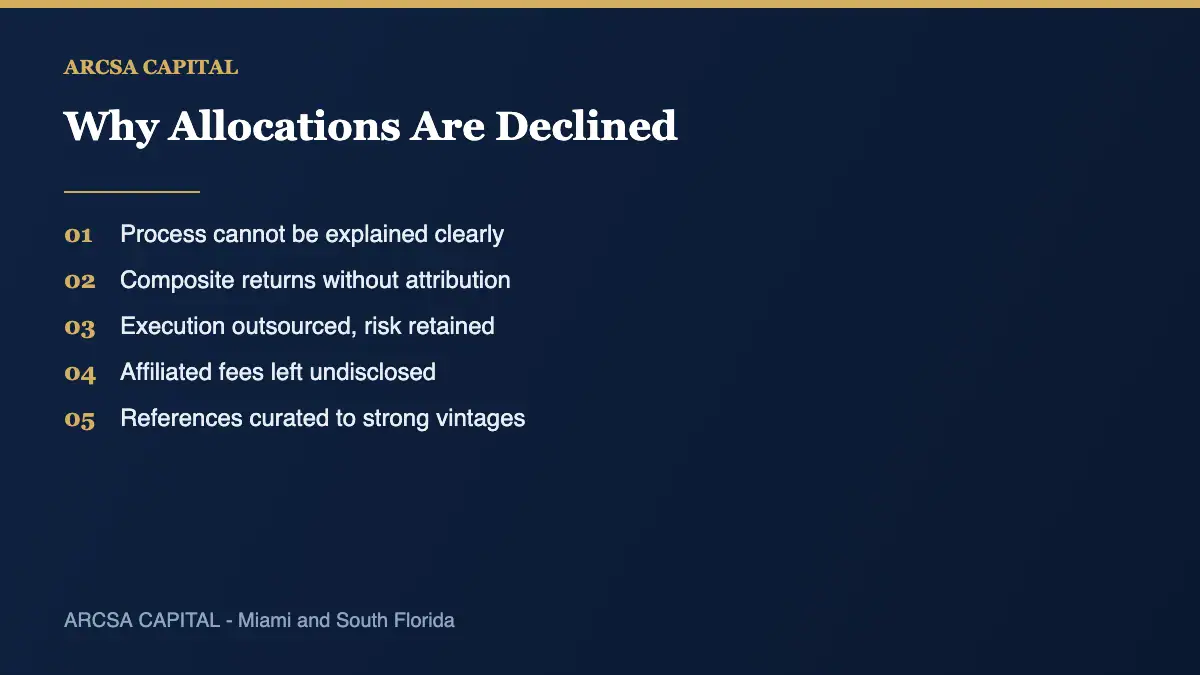
- Accepting a composite return figure without attribution across market, leverage and decisions.
- Judging real estate operators on sourcing ability while ignoring construction and permitting capacity.
- Treating a personal relationship with the principals as evidence of structural alignment.
- Overlooking affiliated property management, construction and brokerage fees charged at the asset level.
- Skipping conversations with existing investors, particularly from a disappointing vintage.
- Allocating before agreeing in writing what reporting will look like after closing.
None of these errors require unusual information to avoid. They require a fixed sequence and the discipline to apply it even when the opportunity feels time limited.
How to Evaluate Real Estate Operators in 30 Days
Week 1 – Fit and people
Confirm mandate, ticket size, hold period and reporting standard against the family office own requirements. Verify the principals prior roles independently rather than accepting the biography as written. Real estate operators who welcome this step tend to be the ones with records that survive it.
Week 2 – Attribution and repeatability
Request transaction level data for every completed deal, not a selected subset, and separate what the market delivered from what the operator delivered. Look for a process that repeats across different assets rather than one exceptional outcome carrying an entire record.
Week 3 – Governance and alignment
Read the partnership agreement in full: decision rights, advisory committee consent, key person provisions, removal mechanics, fee schedule, hurdle, catch up and clawback. Model what the operator earns in a merely acceptable outcome, which is where alignment becomes visible.
Week 4 – Execution and references
Visit an active project if possible, meet the construction lead and ask how change orders are approved. Then speak with two existing limited partners. The best real estate operators are consistent across all three conversations, and inconsistency at this stage is decisive.
Frequently Asked Questions About Real Estate Operators
What matters most to a family office: the market or the operator?
The market defines the range of possible outcomes and the operator determines where within that range the allocation lands. Two firms buying comparable assets in the same submarket routinely deliver materially different results, which is why real estate operators receive more scrutiny than the market thesis.
How is attribution actually tested?
By separating the components of return. Market appreciation over the hold period, the contribution of leverage, and the value created through renovation, repositioning or negotiation are three different things. An operator that cannot decompose its own returns has not analyzed them.
Does vertical integration matter?
Considerably, in residential value add strategies. When construction management and permitting sit in house, cost variance is controlled rather than reported after the fact. Real estate operators that outsource execution retain the risk while surrendering the control.
How much weight should references carry?
A great deal, provided the references are not curated. Ask for an investor from a vintage that underperformed. How the operator communicated during that period is the single most predictive behavioral signal available.
What is the most common reason a family office declines?
Inability to explain process. When the answers to how a deal was sourced, underwritten, executed and exited are vague or inconsistent, family offices decline regardless of the headline numbers, because an unexplained record cannot be relied upon to repeat.
Key Takeaways on Real Estate Operators
- Fit and attribution are assessed before anything else.
- Real estate operators are judged on execution capacity, not sourcing alone.
- Governance and fee architecture must be read as one system.
- Verify the track record through public records at the transaction level.
- Speak with an investor from a weak vintage, not only from a strong one.
- Vertical integration converts cost variance into something controllable.
- An unexplained record is treated as an unrepeatable one.
ARCSA Capital operates as a vertically integrated sponsor in prime residential real estate in Miami and selected Florida submarkets, with transaction level disclosure and asset level reporting for family office allocators. This article is general information and does not constitute legal, tax or investment advice.
Real estate operators should be verified, not trusted
Speak with our team about attribution, governance and execution across prime residential assets in South Florida.
Request InformationOr model your own scenario in the investment simulator
Or receive the ARCSA Capital investment thesis by email, with the entry, stabilisation and exit assumptions behind the strategy:
